” A challenge for those who go. A dream for those who stay behind. “
-Thierry Sabine, founder of the Dakar Rally
Welcome to the 47th running of the Dakar Rally, one of motorsports toughest tests. This year’s edition (taking place from January 3rd to the 17th) will feature 807 competitors battling over 7,700km of Saudi Arabia’s beautiful and daunting landscapes as they seek to capture rally-raids most prestigious crown.
This guide serves as an introduction to this incredible rally for new and returning fans alike.
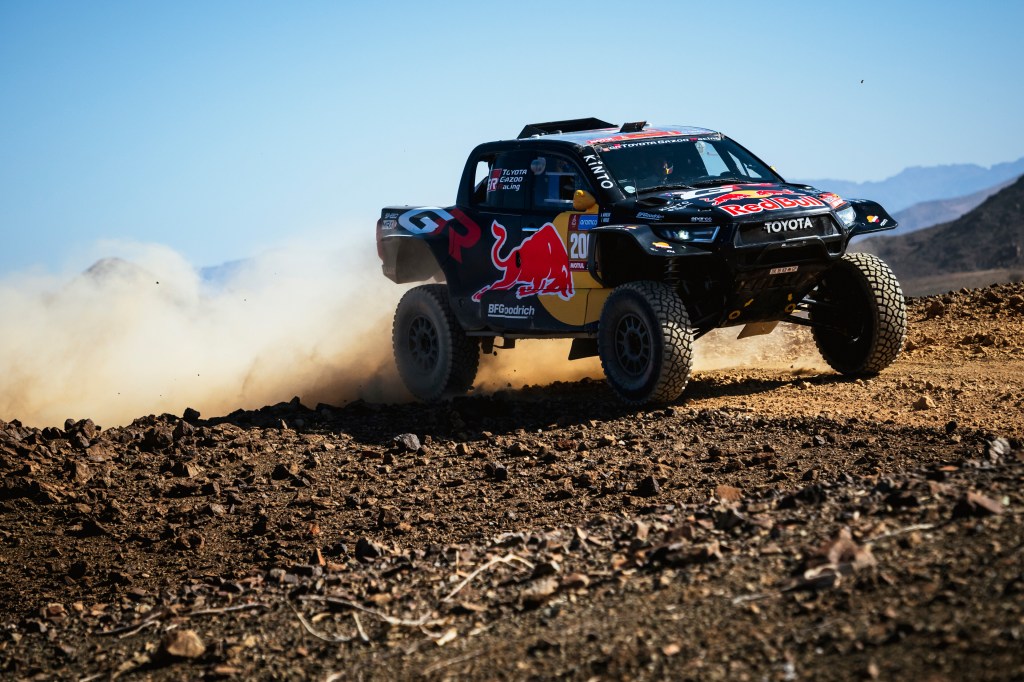
Image courtesy of Marcelo Maragni / Red Bull Content Pool
What is Dakar?
The Dakar Rally is a rally-raid event and the first event of the World Rally-Raid Championship season. The rally is contested over 15 days and 12 stages with each stage taking a day to complete (with the exception of the special 48hr Chrono stage). Competitors are a mix of both professional and amateur drivers. Unlike a traditional rally, a rally-raid takes place off road without a set route for the competitors to follow. Instead, competitors must use the provided roadbook and a GPS to navigate the wilderness, checking in at GPS waypoints along the way to find their way through the stages.
At the end of each day competitors spend the night in the bivouac (a campsite that follows the race), where they are able to work on their vehicles and bond with their fellow competitors. “The Spirit of Dakar” arises from these bonds and is a key feature of the race. Despite being a competition, competitors are expected to help each other when encountering problems such as difficult terrain or mechanical issues. Dakar is one of the toughest challenges in the world, 50% will likely fail to complete the event, making finishing the rally-raid a huge accomplishment.
A Brief History of Dakar
As the competitors prepare to conquer Saudi Arabia you may find yourself confused as to why the world’s greatest rally-raid shares its name with Senegal’s capital, Dakar. The Senegalese capital was the original finishing location of the rally which began its life as the “Paris-Dakar Rally.” Thierry Sabine, a French motorcycle racer, came up with the idea for the rally after getting lost in the Ténéré desert while competing in the Rallyé Côte-Côte. Savine became enthralled with the desert landscape and dreamed up a race from Paris to Dakar. On December 26th 1978, the inaugural Paris-Dakar rally kicked off in Paris with 182 vehicles making the 10,000km journey to Dakar.
The event would continue to soar in popularity, with 603 competitors competing in the 1988 event. The rally-raid would go on to see a mix of popular and less popular years, the route itself would also change, sometimes being held exclusively in Africa or starting in different European cities. By 2007, the Africa era had come to an end, with security concerns caused by growing Islamic terrorism in North Africa forcing the cancelation of the 2008 event.
Dakar would return in 2009, now being held in South America through various countries throughout the years. The South America era would last until 2019, with the rally moving to Saudi Arabia for the 2020 season and beyond. In 2022 the World Rally-Raid Championship would be created jointly by the Fédération Internationale de l’Automobile (FIA) and the Fédération Internationale de Motocyclisme (FIM) to give rally-raid it’s own world championship which Dakar now serves as the opening event for.
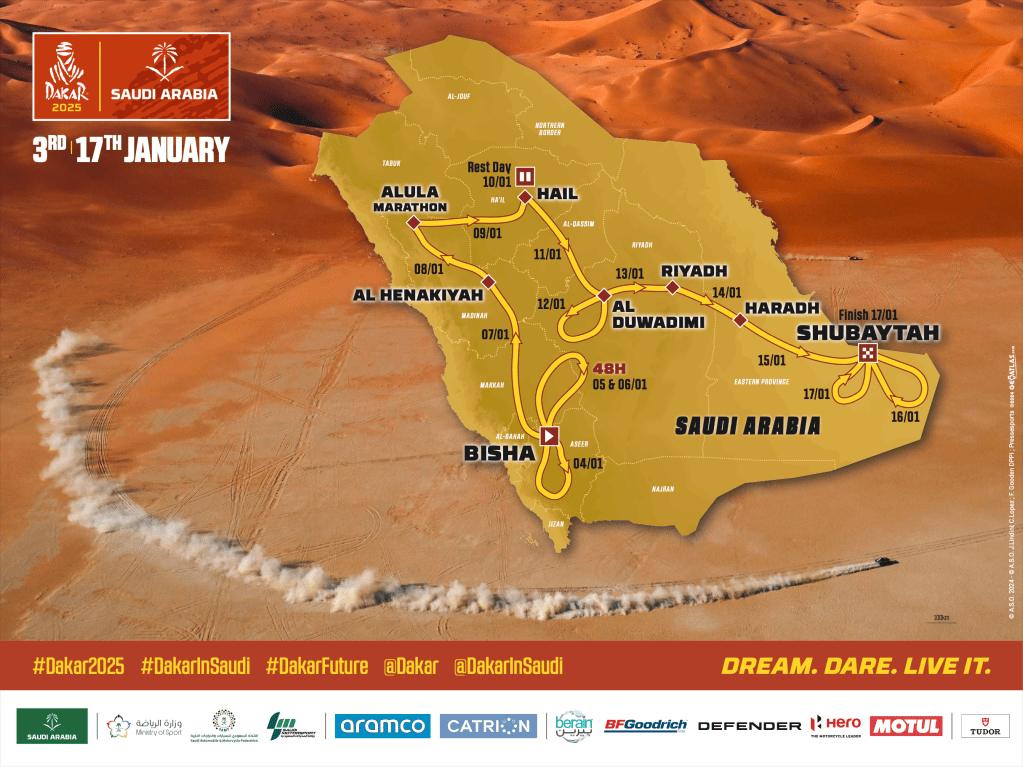
Image courtesy of Dakar
The 47th Dakar Rally: What’s New?
2025 will mark the 47th edition of the Dakar Rally and the sixth year the event takes place in Saudi Arabia. This year’s event will take competitors over 7,700km from Bisha to Shubaytah, featuring a return of fan-favorite challenges and a few new changes:
48hr Chrono Stage: Last year saw the debut of the 48hr stage which quickly became a huge hit with fans. This year it returns and now features at the beginning of the rally on Stage 2. The 48h Chrono Stage challenges competitors with a 1,000km stage taking place over two days. At 5pm of the first day, competitors must report to the nearest bivouac where they will only have access to tents and rations before heading out at 7am the next morning.
Mass Start: Returning after many years is the mass start, where all competitors will all be unleashed at once in an epic side-by-side finish for the final stage of the rally.
Split Stages: Bikes, Cars and Trucks will now have different routes to follow for some of the special stages. This has been done to prevent cars from following the tracks of the bikes and with safety in mind as the truck’s deep tracks have caused problems for those categories starting behind them.
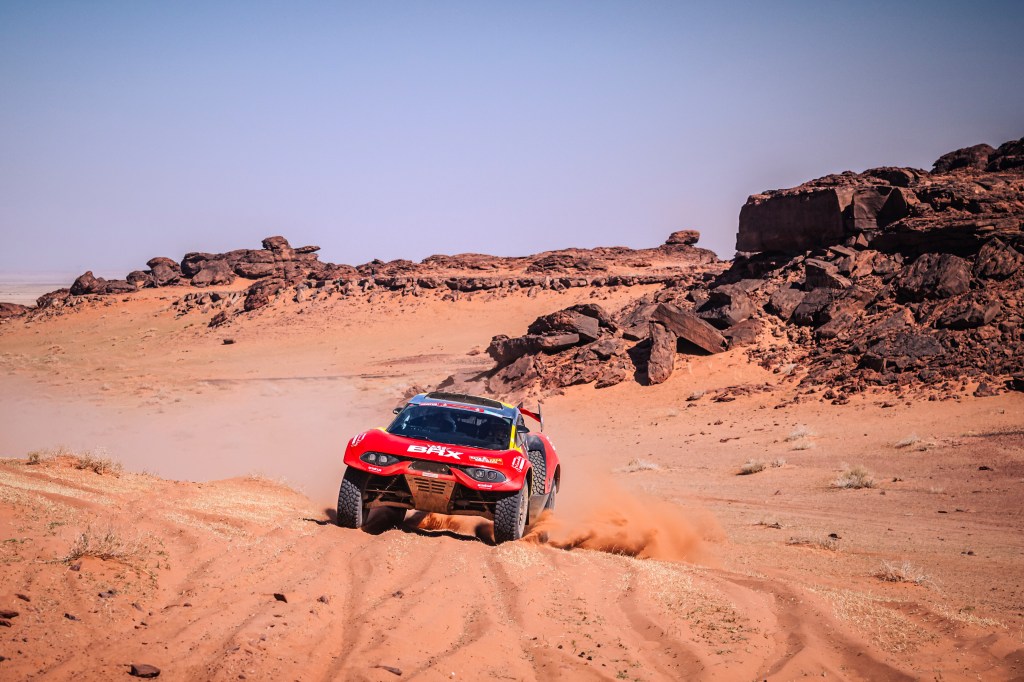
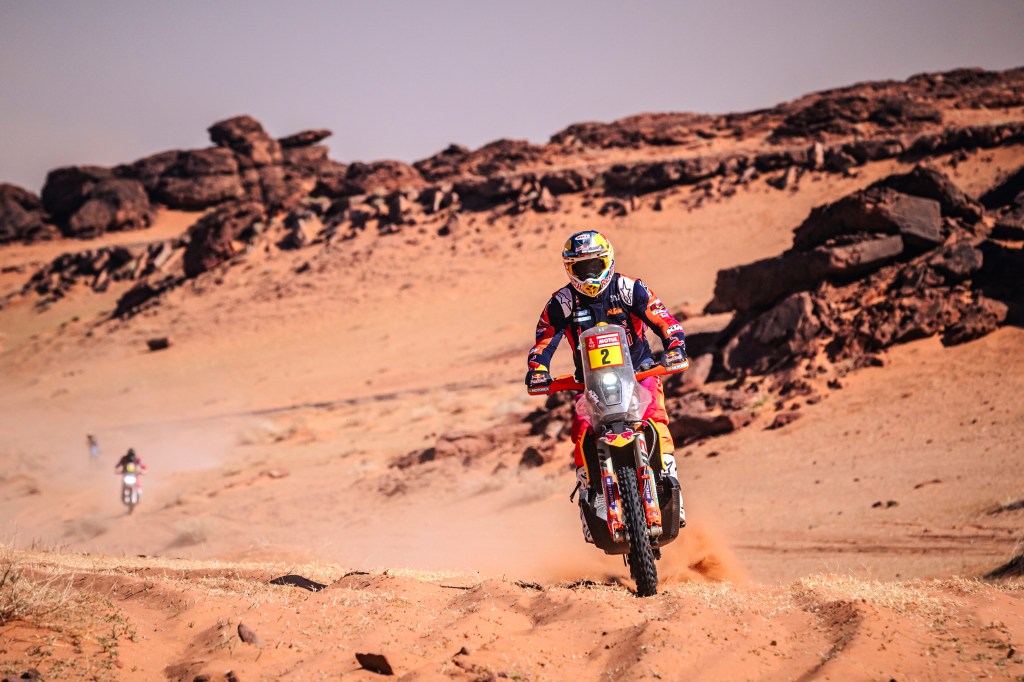
Image courtesy of Marcelo Maragni / Red Bull Content Pool
Categories
This year’s edition will feature four primary categories: Cars, Bikes, Challengers and Trucks. The Quads category has been dropped this year due to the declining field and support in past years. Two special categories will also be returning: Classic and Future Mission 1000.
Cars: The cars category features six classes, T1.+, T1.1, T1.2, STK, T2.1 and T2.2. These classes range from prototype cross-country vehicles all the way down to production cars. Car crews feature two competitors, a driver and a navigator. Manufacturers this year includes the likes of Toyota, Ford, Dacia and Mini.
Bikes: The bikes category features two classes, RallyGP and Rally2. These classes range from powerful off-roading bikes, RallyGP, to their less powerful counterparts in Rally2. Bike crews feature just one competitor, who must serve as both the rider and navigator. Manufacturers this year includes the likes of Honda, KTM, Hero, Yamaha and more.
Challengers: The challengers category features two classes, T3.U and T3.1. Both classes feature prototype cross-country buggies split by power. Underneath the Challenger category is its sister category, SSV (Side-by-side vehicles). The SSV category is split into three classes, SSV1, SSV2 and T4. This category features a range of modified production cross-country buggies. Challenger crews feature two competitors, a driver and a navigator.
Trucks: The trucks category features massive off-road trucks split into three classes, T5.U, T5.1 and T5.2. These classes range from prototype cross-country trucks down to production trucks. Truck crews feature three competitors, a driver, navigator and mechanic. Manufactures this year includes the likes of Iveco, Tatra, Hino, Scania and more.
Special Categories: This year’s edition sees the return of the Classic and Future Mission 1000 categories. The Classic category features a variety of classic cars driven by mostly amateur crews who participate in a regularity rally version of Dakar. Future Mission 1000 features cars using new technology looking to be tested in the ultimate environment. These cars use a mix of electric, hydrogen or hybrid powertrains and are scored under a special set of rules.
How to Watch Dakar
Due to the remote nature of the event, live video coverage isn’t available. Instead, daily recap coverage is the main way fans follow the rally-raid. At the end of each day, the official Dakar YouTube Channel posts a daily recap video to keep you up to date on the rally. Your country might also have a local broadcaster doing a daily recap show for the rally, you can check the list of local broadcasters on Dakar’s official website or in the image below.
For those interested in following along live there are a few options. Following your favorite competitors and teams social channels is the best way to get the most up to date information on their progress. Dakar’s official website and app also have a live updating leaderboard so you can keep track of your favorite competitors’ times as they progress through the rally.
Image courtesy of Dakar
Important Terms
Below is a collection of important terms you will encounter as you follow Dakar:
Arrivé Special Stage (ASS): The end of a special stage, competitors transition to the liaison section which goes back to the bivouac from here.
Bivouac: A large campsite housing both competitors, their support staff, organizational personnel and media. This is where everyone involved with the rally eats, sleeps and works between stages.
Départ Special Stage (DSS): The beginning of a special stage, competitors transition from the liaison section to a special stage here.
Liaison Section: The part of the stage between the bivouac site and the start of the special stage, and between the end of the special stage and the next bivouac site. This section is not timed and follows a set route.
Prologue: The opening stage of Dakar, effectively a short qualifying stage. The top 10 finishers in the FIM and FIA fields choose their road order position for Stage 1.
Roadbook: A navigational guide given to competitors before each stage. The roadbook is a step-by-step guide to the stage giving competitors loose directions and specific distances between GPS waypoints. Competitors use this to navigate the stage and find the finishing point.
Road Order: The order in which competitors start a stage. Unlike Formula 1, it is usually a disadvantage to start a stage in first. It is easier, and quicker, to follow your competitors tracks. Road Order is set by the finishing positions of the previous stage.
Special Stage: The competitive part of a stage where the competitors are timed as they attempt to navigate the stage off-road using their roadbook. Each time set in a special stage is added cumulatively (including penalties) to determine a competitors position in the classification standings.
Stage: The total distance a competitor will drive any given day, which begins and ends at a bivouac site. A stage is broken up into two parts, the liaison section and the special stage.


 Dirt 2 Asphalt